Hallmark / Circle STARK verifiable inference
Prove
LLM inference.
A pinned TinyLlama-1.1B answers a question; 23 linked Circle STARK proofs show it computed every token. Three classifier verdicts on the same prompt get proofs of their own.
Fixed model and prompt · Public witnesses
Research software · MIT licensed
- GPU proving session
- 53.94 s
- LLM bundle check
- 3.40 s
- Nine classifier proofs
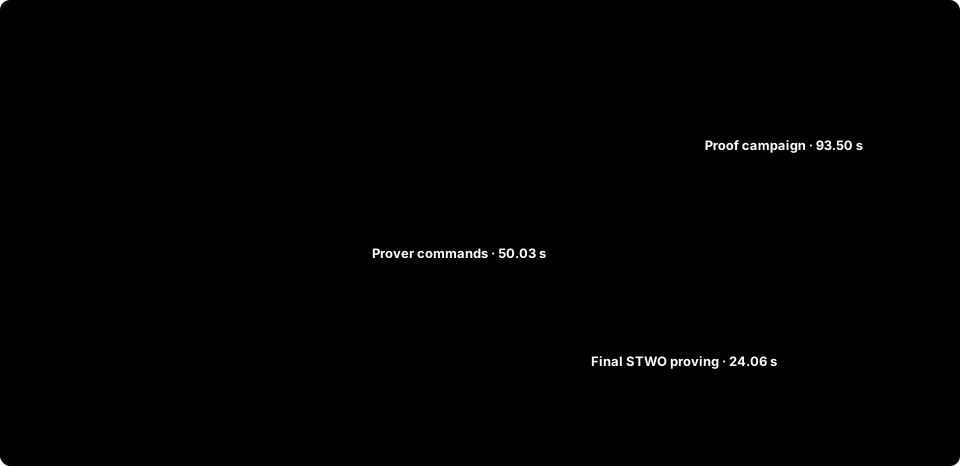
- 24.06 s
- Nine verifications
- 0.807 s
23 TinyLlama segments on one H200; 547.75 s on CPU
Native Mac verifier, roots compiled in; 3.40–3.53 s
Final STWO proving calls on an Apple M4 Max
Fresh proof-only processes, same Mac

Learn
What a verifier checks, and how the caller fixes the model and inputs it expects. No cryptography background required.
Read the learning guide →Run
Prove classifier decisions on a Mac, prove the TinyLlama answer with HF Jobs, or benchmark the prover on an H200.
Choose a workflow →Check
Download the actual proofs, then check the statements, hashes, raw measurements and failed runs behind each result.
Get the proofs →What the LLM proof covers

The prompt becomes 25 tokens; one 32-position block holds them plus the first seven answer tokens. SASH proves the embedding, all 22 transformer layers and the final norm and output head as 23 segment proofs joined by 22 residual links. The head's argmax at positions 24–31 gives the eight answer tokens, and seven of them must equal the next input, which closes the loop through EOS.
The proof covers the disclosed quantized model. Equivalence to the original floating-point model, hardware provenance and witness hiding are not claimed. The exact statement.
What a classifier proof states

What verification establishes
A valid classifier proof can return “block” for a harmless prompt. The proof checks the computation; whether the policy is any good, and whether its inputs are authentic, need separate evidence.
Where the proof ends

Recorded measurements

| Observation | Recorded result | Read it in context |
|---|---|---|
| L1 GPU proving-session timer | 53.94 s, versus 547.75 s SIMD | Session boundary and raw segment logs |
| L1 complete segment commands | 155.89 s, versus 679.49 s SIMD | Includes loading, trace generation, proving, inline verification and serialization |
| L1 full-bundle verification | 84.32 s CPU grid on the H200 host; 3.40–3.53 s compiled-root Mac checks | Different preprocessing, same proof payload |
| L1 actual LLM proof JSON | 737,858,641 bytes across 23 proofs | Download proofs, statements and claims |
| C1 nine classifier proofs | 24.061 s final STWO calls; 50.028 s complete prover processes | Every stage and per-proof record on M4 Max |
| C1 classifier verification and size | 0.807 s in nine fresh verifier processes; 18,063,779 proof bytes | Actual proofs, caller inputs and logs |
| C1 complete controller | 302.96 s, including fresh training, builds, proofs and checks | Excludes uv bootstrap; one instrumented observation |
L1 and C1 are separate component runs on different machines, not one measured end-to-end workflow, and one run is not a distribution. The performance guide explains every timer boundary, and the evidence map links the raw JSON, controls and missing claims.
Published classifiers
| Model | Architecture | Card, weights and provenance |
|---|---|---|
| Byte MLP | 1,033 parameters; byte counts and four hidden ReLU units | Hugging Face ↗ |
| Contextual byte CNN | 4,161 parameters; causal convolution and masked max pooling | Hugging Face ↗ |
Both are trained from scratch on synthetic fixtures. Dedicated STWO Circle STARK circuits prove decisions from their integer exports. Download a pinned model, read its model card, or train and prove it yourself. These are research classifiers, not operational safety filters.